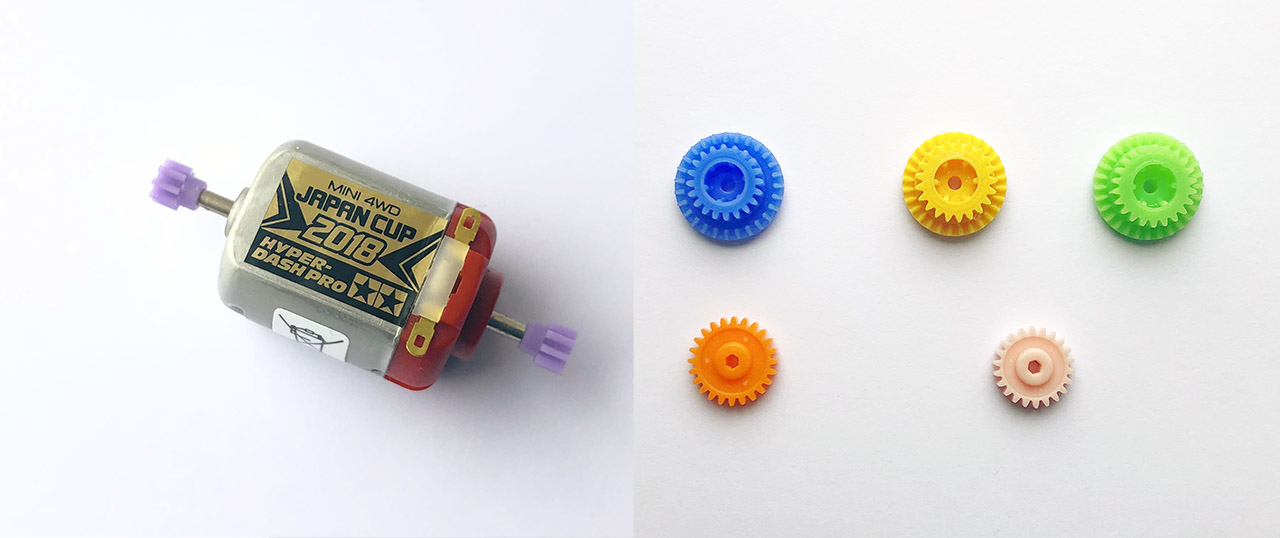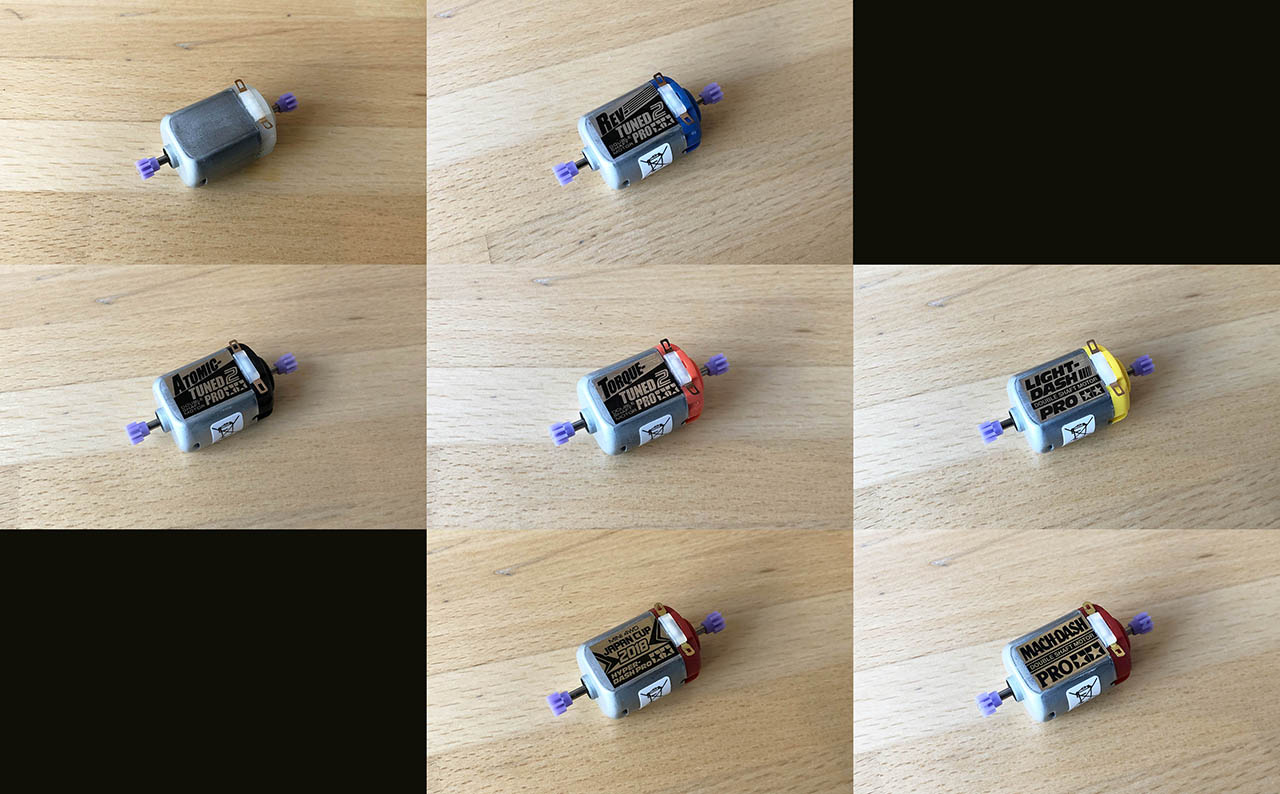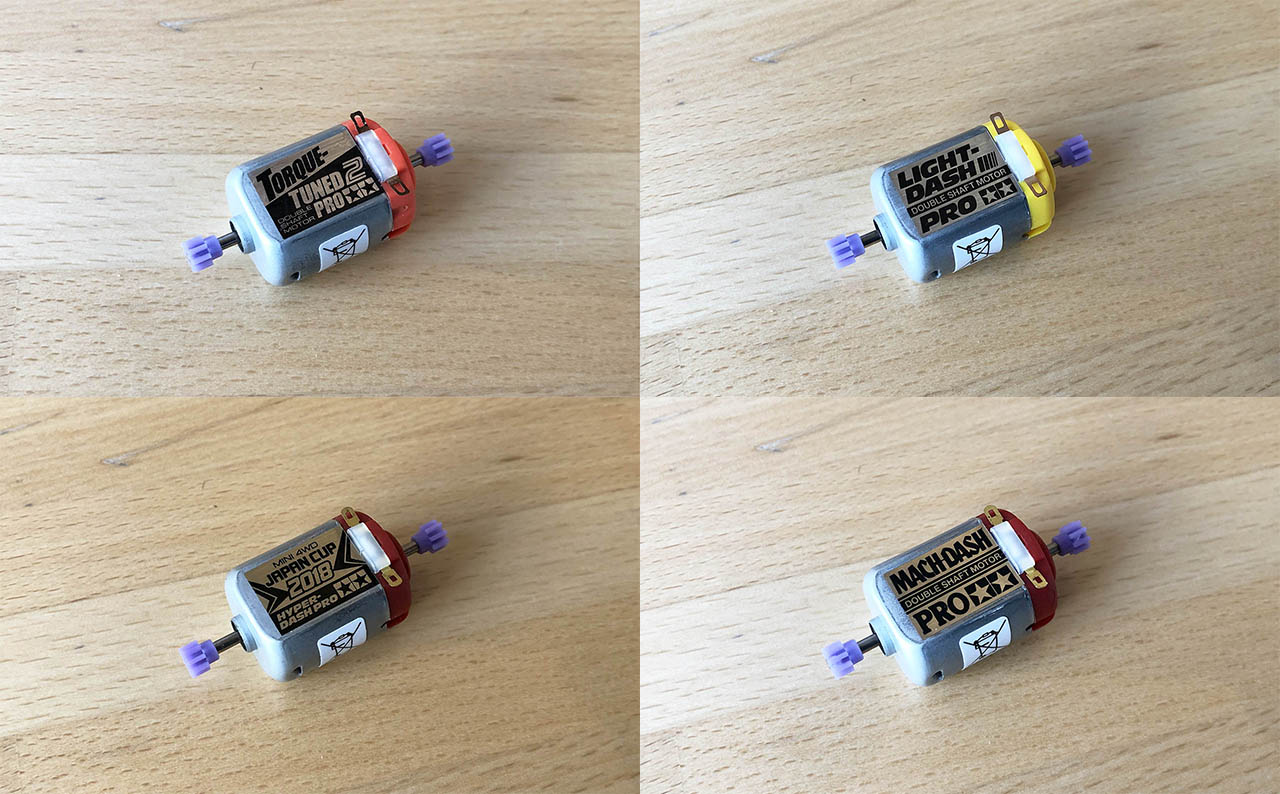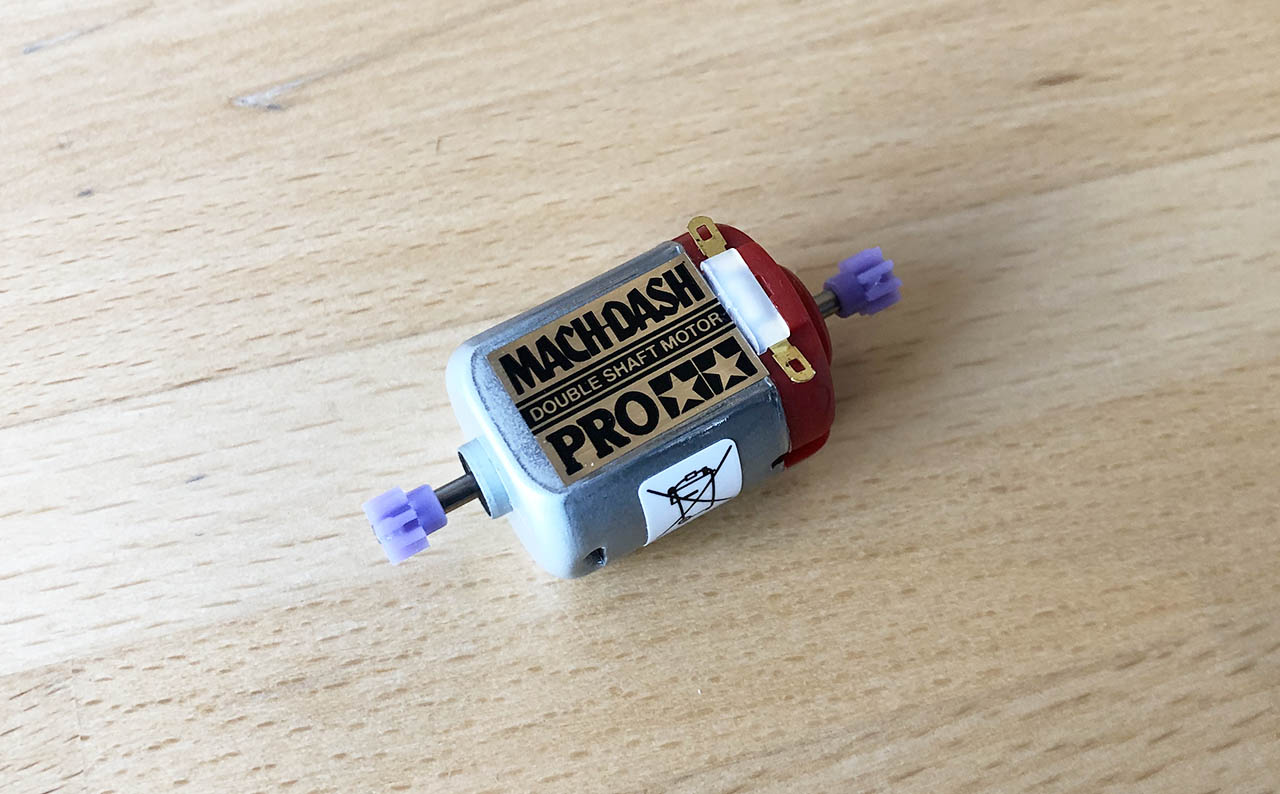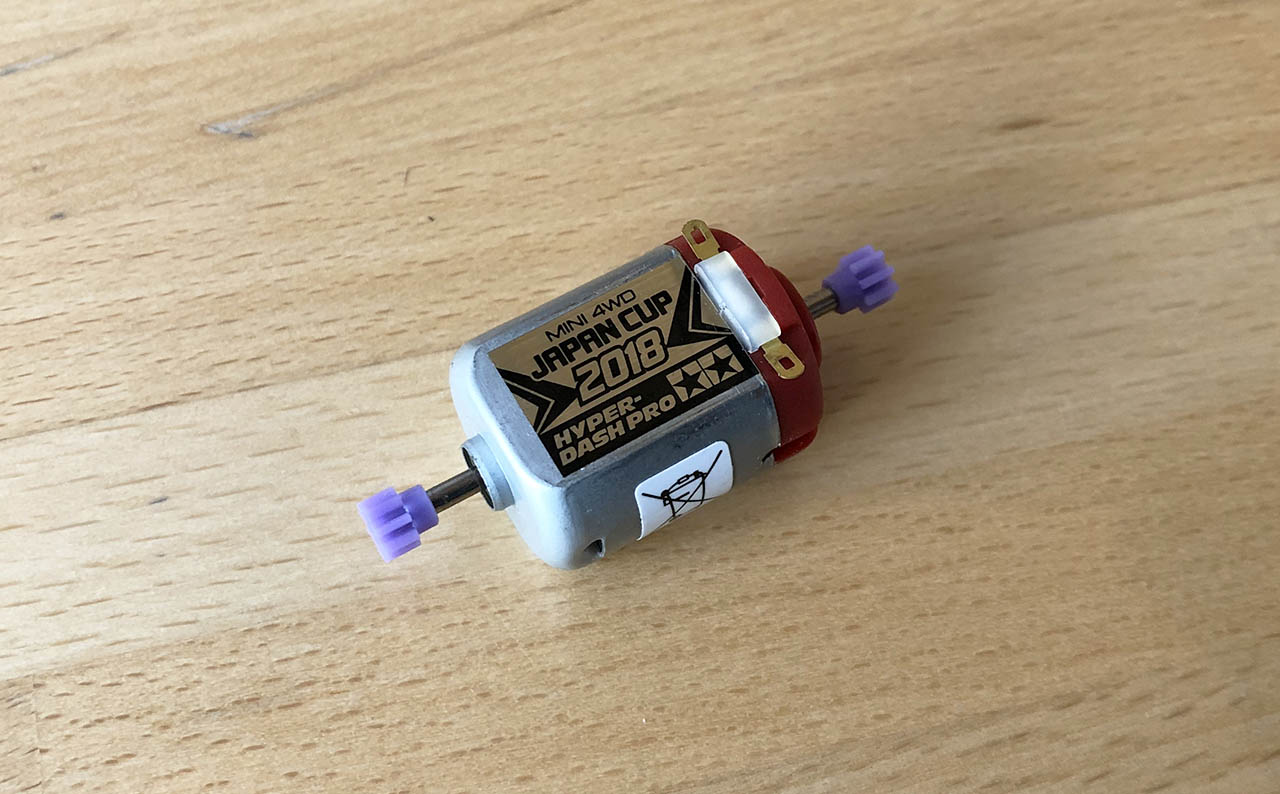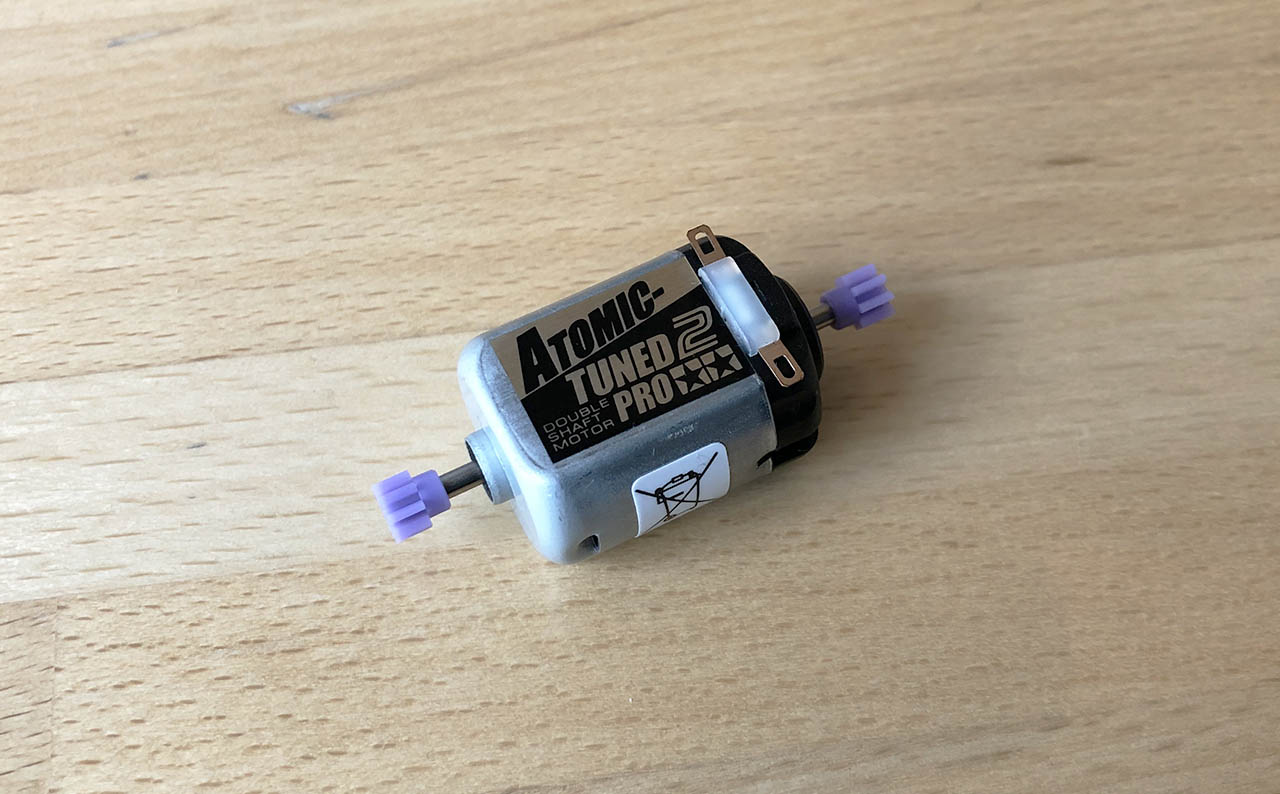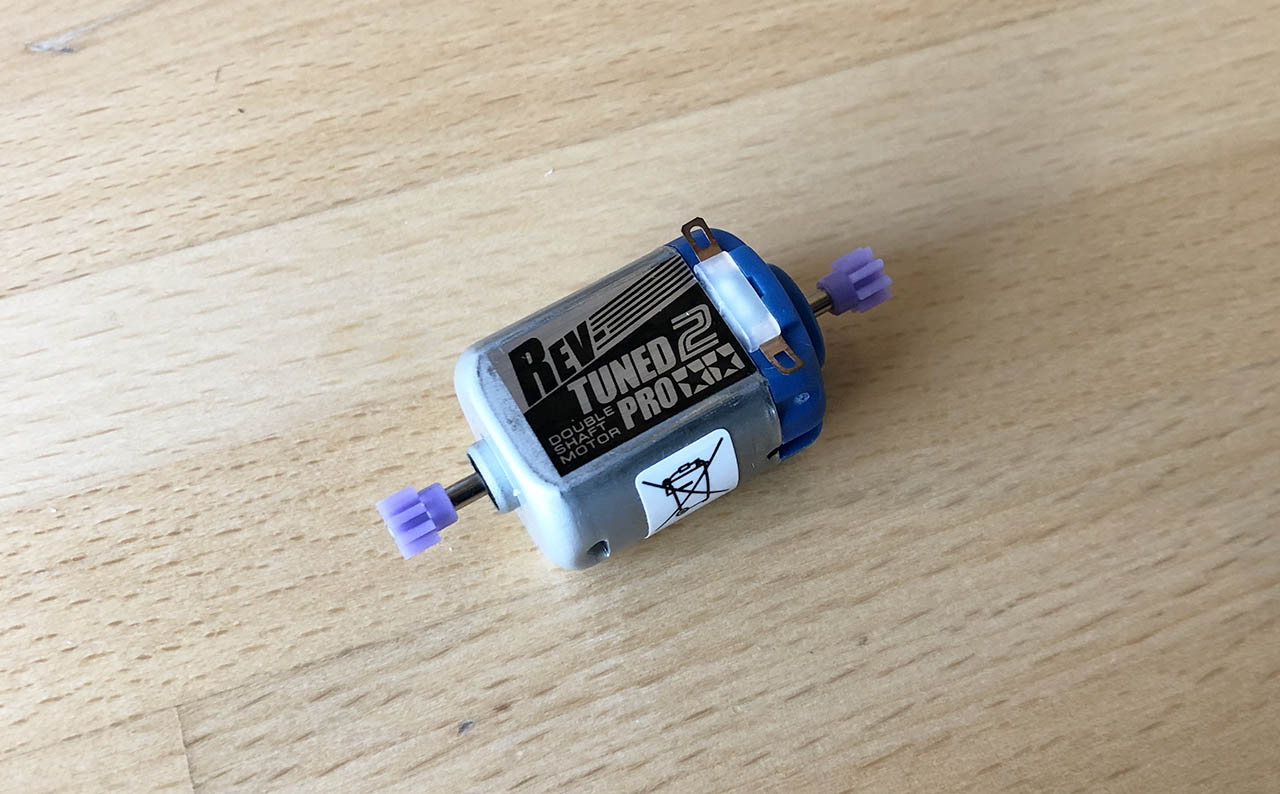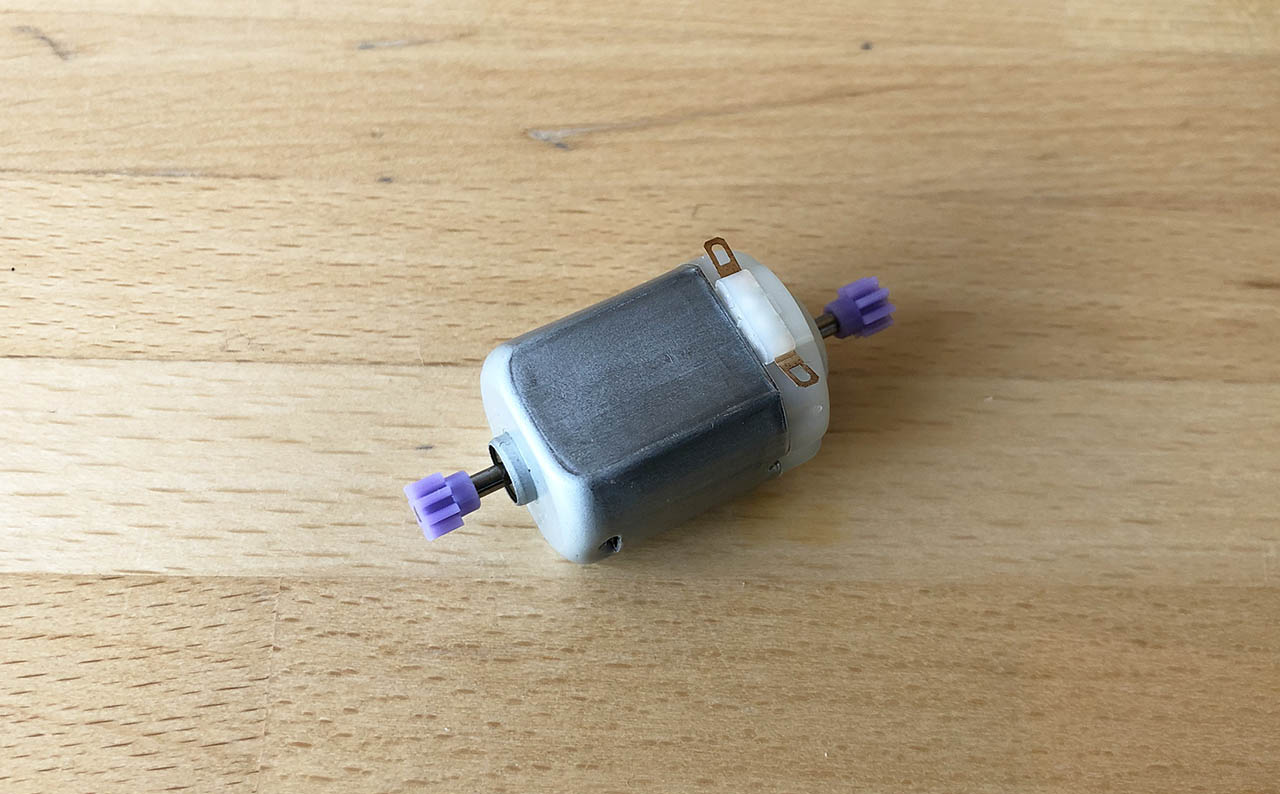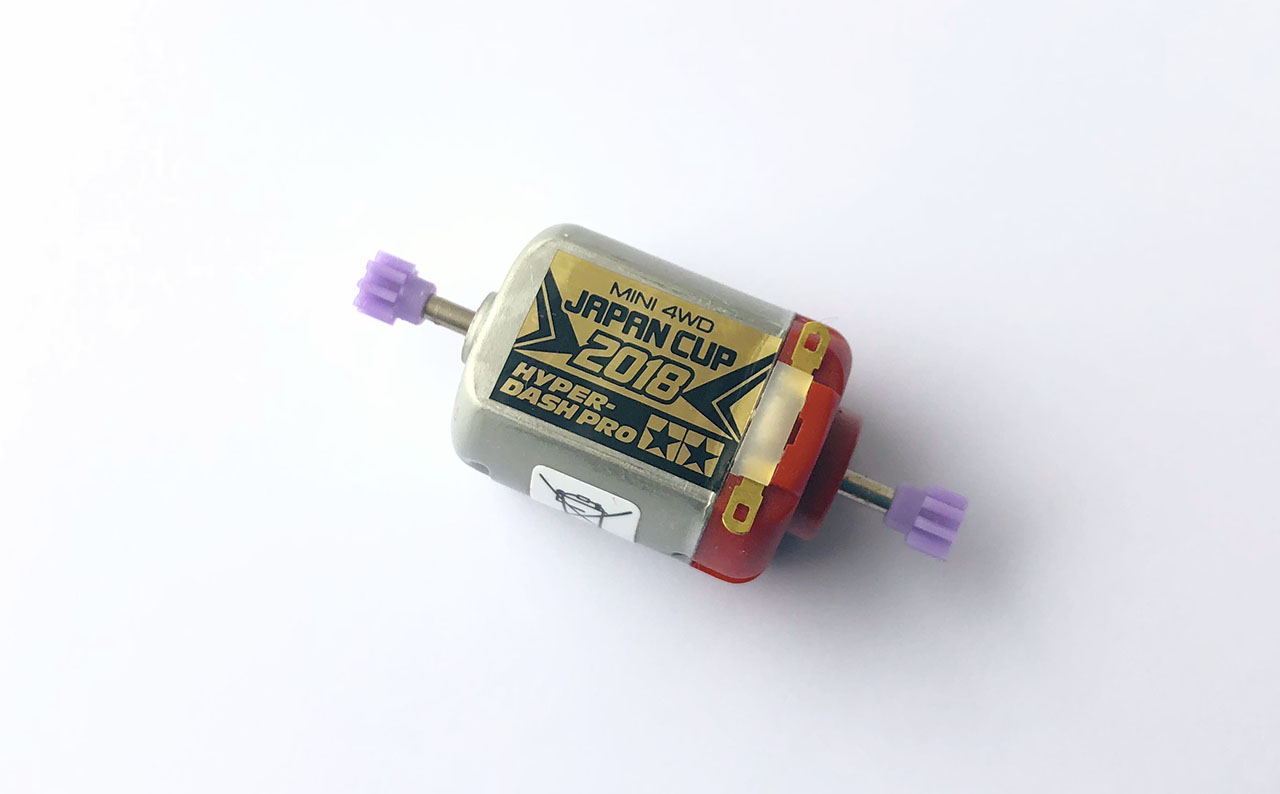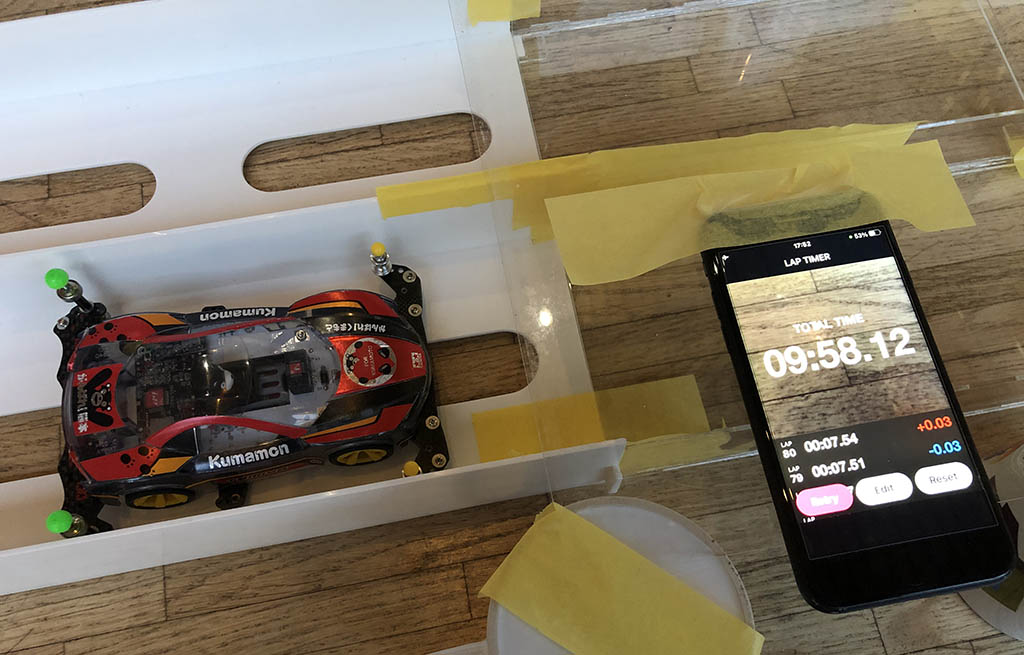
What is the ultimate gear ratio for the Tamiya Mini 4WD Hyper-Dash PRO motor? To answer that, we put the 4:1, 3.7:1, and 3.5:1 ratios to the test. In this guide, we dive into the data from our custom inertia dyno experiments to uncover the fastest setup, the slowest setup, and the science behind how they perform on the track.
Background
Since our first motor and gear ratios matching test left us with an unexpected twist—and a lot of questions. To find definitive answers, we knew we needed a better testing setup for the Tamiya Hyper-Dash PRO. Now, thanks to our newly developed direct-drive inertia dyno, we can finally re-test in a fully controlled environment and analyse the motor’s performance at a much deeper, more granular level.
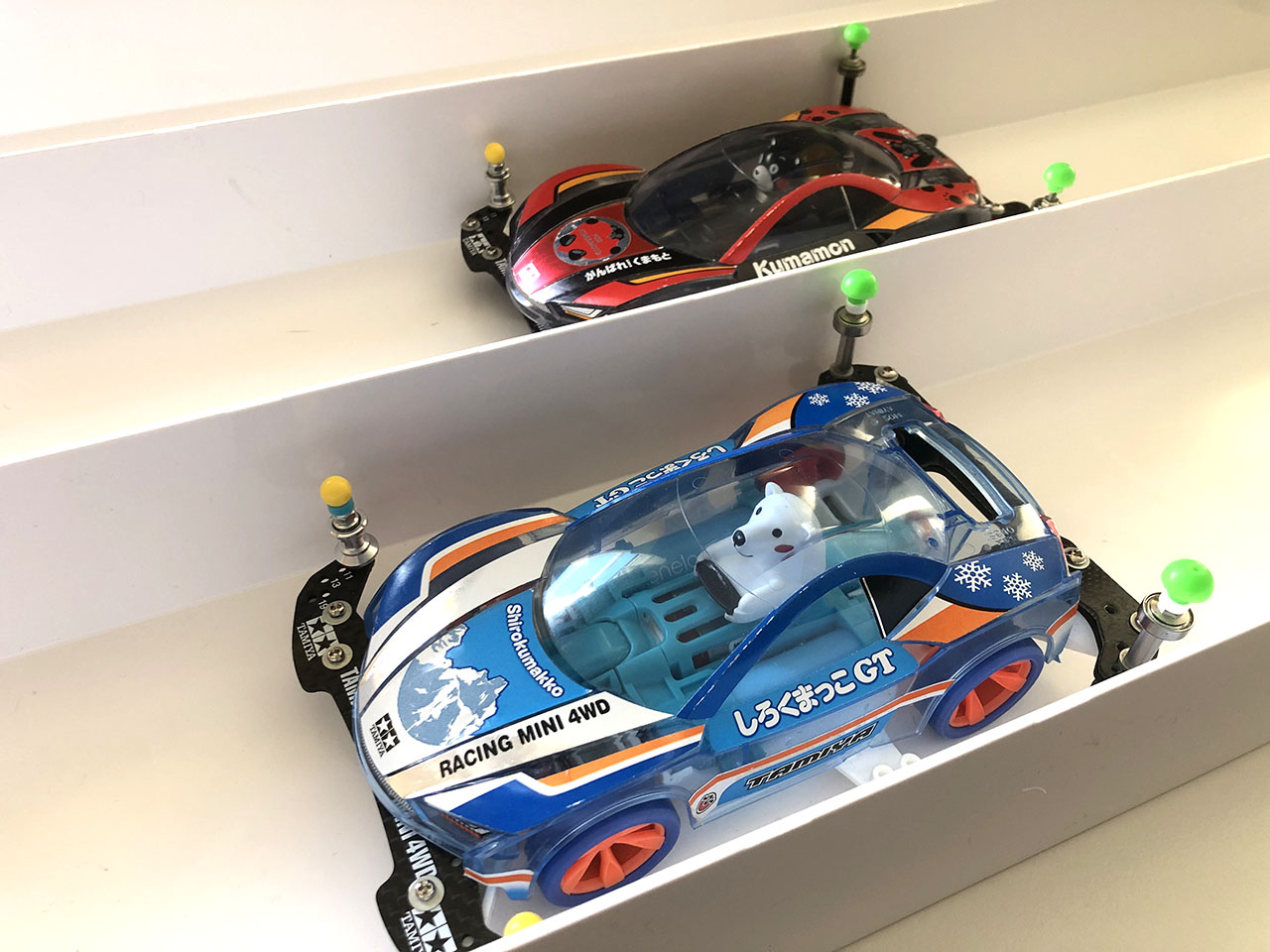
Our test car with an MA chassis can equipment with three different gear ratios:
- (A) the blue and orange High Speed Gear Set (Gear Ratio 4:1) – Item No: 15355
- (B) the yellow and pink High Speed EX Gear Set (Gear Ratio 3.7:1) – Item No: 15429
- (C) the green and pink Super Speed Gear Set (Gear Ratio 3.5:1) – Item No: 15349

On paper, the blue and orange High Speed Gear Set (4:1 ratio – actually 4.05:1) should give us the best acceleration. The yellow and pink High Speed EX Gear Set (3.7:1 ratio – actually 3.66667:1) should offer a balance between the two. Finally, the green and pink Super Speed Gear Set (3.5:1 ratio) should deliver the highest top speed.
Do they perform as expected? And ultimately, which gear ratio is actually the best?
The Test
Test Scenarios
We designed three tests:
- 100-Metre dash
- 0 to 5 m/s test
- 3 to 5 m/s test
1) The 100-Metre Dash: Overall Efficiency & Top-End Power
This test evaluates a mix of launching ability, acceleration, and sustained top-end speed over a massive distance relative to typical Mini 4WD tracks.
- Lower gear ratios (like 3.5:1) will likely dominate this test. Because 100 metres gives the car plenty of time to fully exit its acceleration phase, the higher top-speed ceiling allows it to make up for any sluggishness off the starting line.
- What it tells you: It reveals your “true” high-speed efficiency and whether your motor has the torque required to pull a taller gear ratio all the way to its theoretical peak RPM under load.
2) 0 to 5 m/s: Low-End Torque & Static Inertia Breakdown
This is a pure measurement of dead-stop acceleration and static friction breakdown. A speed of 5 m/s is roughly the lower-to-middle bound of a Hyper-Dash PRO’s optimal power band (~1 to 4.3 m/s on track layouts).
- Higher gear ratios (like 4:1) should cleanly win this test. The extra mechanical advantage multiplies the motor’s stall/starting torque at the axle, snapping the dyno flywheel out of inertia much faster than a 3.5:1 ratio can.
- What it tells you: This mimics a car launching from the starting gate or recovering speed from a near-complete stop, such as clearing a harsh section like a standard bank change or a heavy 90-degree corner.
3) 3 to 5 m/s: Mid-Range Recovery & In-Run Acceleration
This is the most critical benchmark for modern, technical MS/MA/ME chassis racing. Rather than measuring a launch from a standstill, this tracks recovery acceleration while the motor is already spinning.
- Balanced or Taller Ratios (3.7:1 or 3.5:1) often show surprising advantages or highly competitive times here. At 3 m/s, the motor is already out of its high-current stall phase and climbing right into its peak horsepower sweet spot (~5,000 to 11,000 motor RPM).
- What it tells you: This simulates how quickly your car recovers its pace after landing a jump, clearing a lane change, or exiting a sweeping corner where it scrubbed off a little velocity but didn’t come to a dead stop.
- How we tested it: While traditional setups can’t isolate this data, our AI Mini 4WDs allowed us to stabilize the car at a steady 3 m/s cruise before triggering maximum power acceleration.
Test Rig: Simulating the “Worst-Case Scenario”
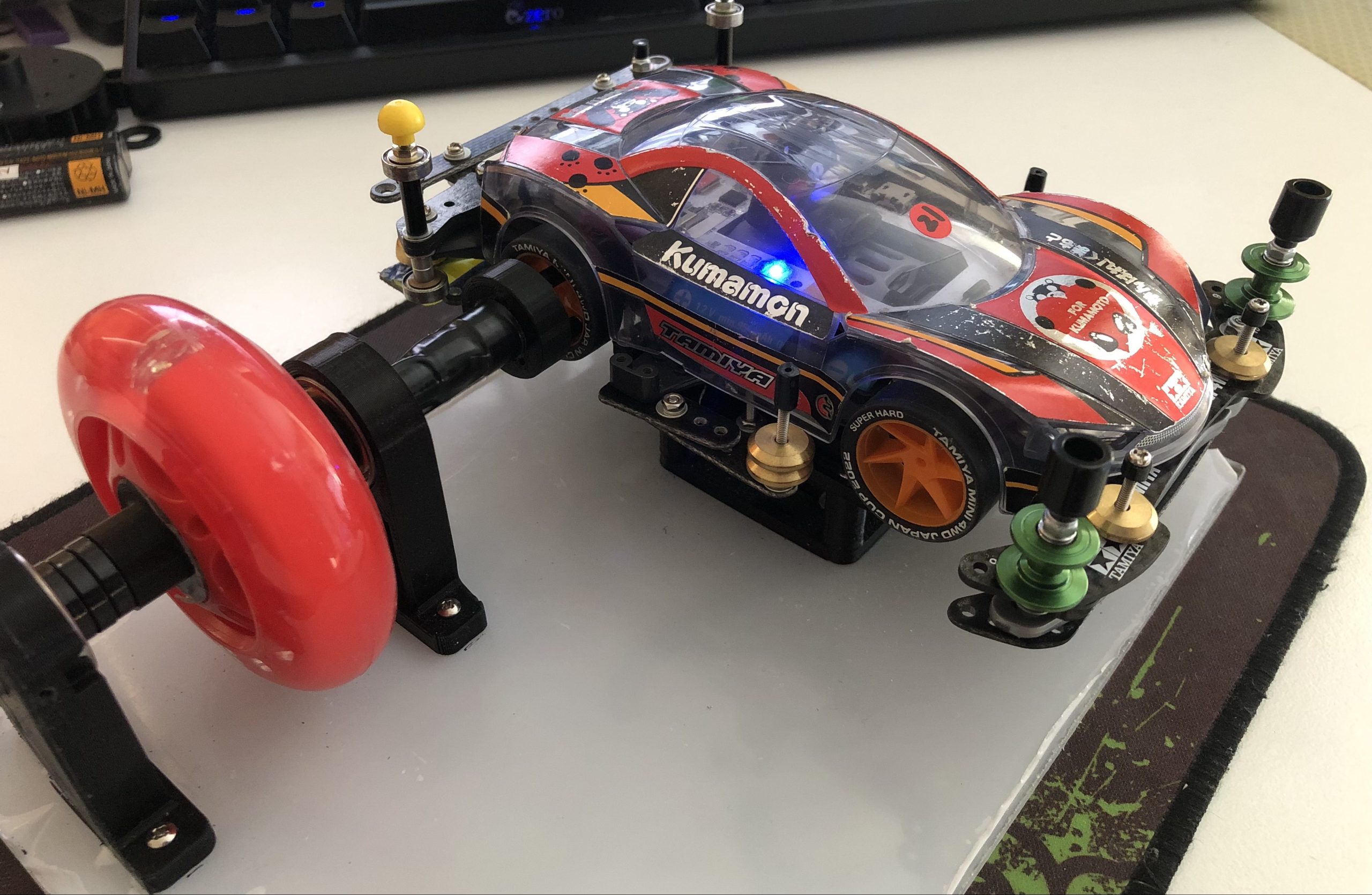
To get these numbers, we didn’t just spin the wheels in the air. We strapped the rear wheel of our AI Mini 4WD directly to a heavy axle dyno using a custom 3D-printed coupler and a 97g roller skate wheel. Because this setup has high inertia, it acts as a torture test for motor torque. It perfectly simulates heavy track scenarios—like pulling out of a harsh grass section, climbing a steep 45-degree bank, or slamming the throttle after landing a jump where the car has lost all its momentum.
Test Car
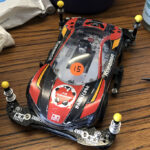
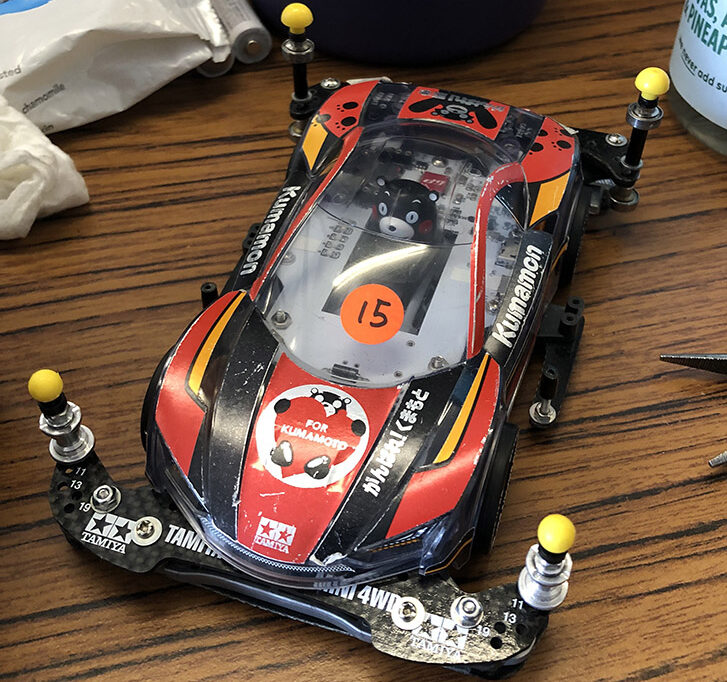
Car: Our Mini 4WD Mark 8L Development Prototype based on the Kumamon car. For more information please refer to Our Mini 4WD page.

Chassis: MA Chassis
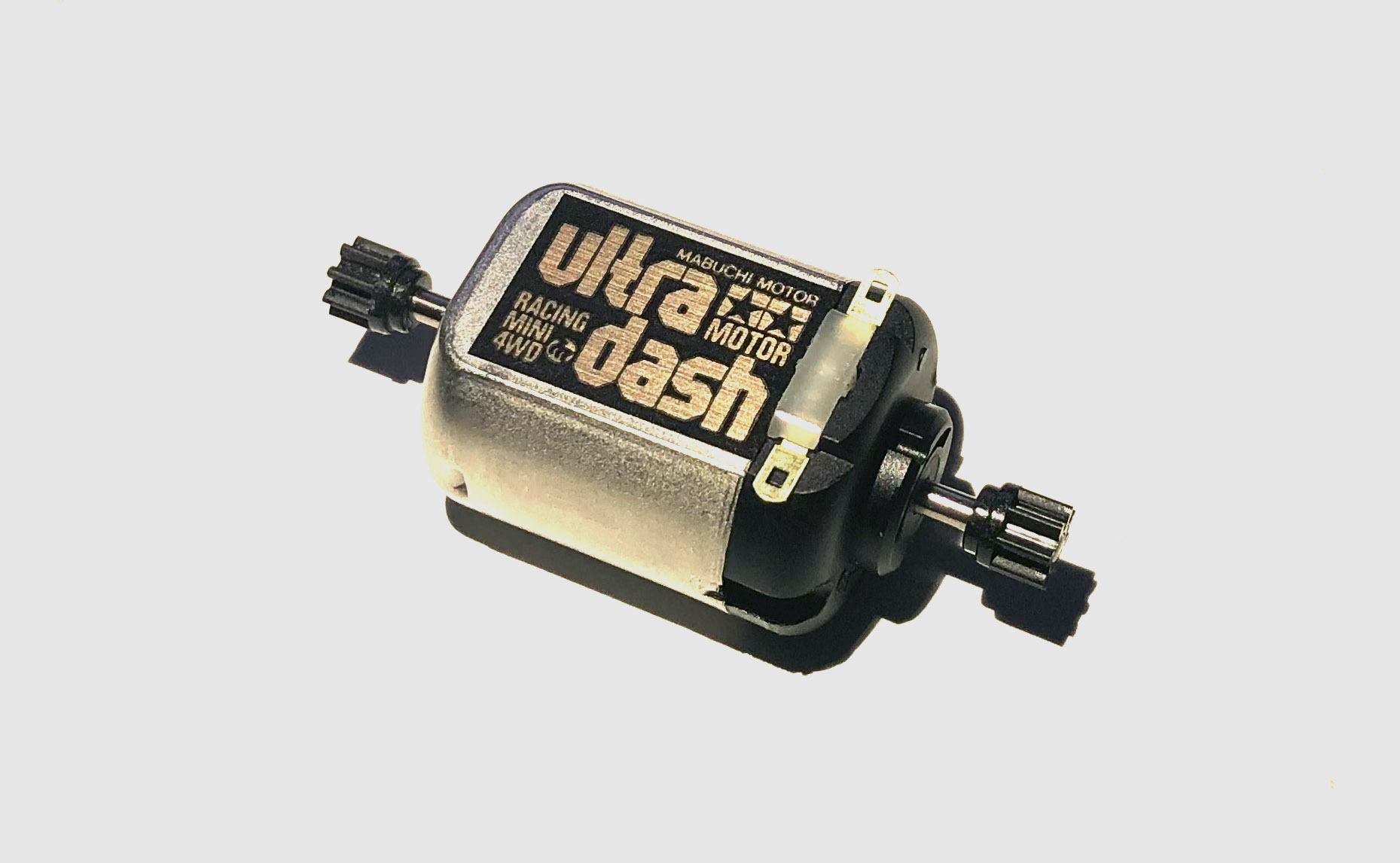
Motor: Tamiya Mini 4WD Hyper-Dash PRO
Gear Ratio(s): 3.5:1, 3.7:1, 4:1
Wheel Diameter including tyres: 2.61 cm
Battery: Eneloop AA Light 950mAh batteries
Mass: 192 grams
Telematics: Custom built A.I Mini 4WD Mark 8L computer to run the measuring program and to record data. It contains a Atmel ATSAMD21 Cortex M0 48Mhz processor (Arduino Zero), 6-axis gyroscope and accelerometer (MPU6050), high speed microSD Card to record data, a quartz crystal to help measure accurate time and a tachometer to measure distance.
The on-board computer measures distance, time, acceleration and rotation every 10 milliseconds (0.01 seconds or 100 times a second) and records the data in the onboard Micro SD card in a CSV file format. After every run, I download the data to my laptop and analysis each run using our analytical tool while charging the battery and cooling down the motor. Our analytical tool enables us to analyse the results, calculate performance figures and generate some nice charts.
Test Approach
We ran 3 separate test cycles averaging three clean runs across three different gear ratios: 3.5:1, 3.7:1, and 4.0:1. It means we had to let the car cooled down and get our batteries charged up to full 18 times in order to complete the whole experiment. It was very time consuming but it was worth it.
Calibration
See information in our previous article.
Considerations
Resistive forces such as air friction and mechanical friction of the test system can affect the outcome. The condition of my batteries e.g. charged voltage and internal resistance, motor condition e.g. run-in or worn out and electrical resistance in the circuit can also affect the outcome. Hence we ran the same test three times and took an average of the results to help iron out any anomaly.
The Results: Which Gear Ratio Wins?
100-Metre Dash Test
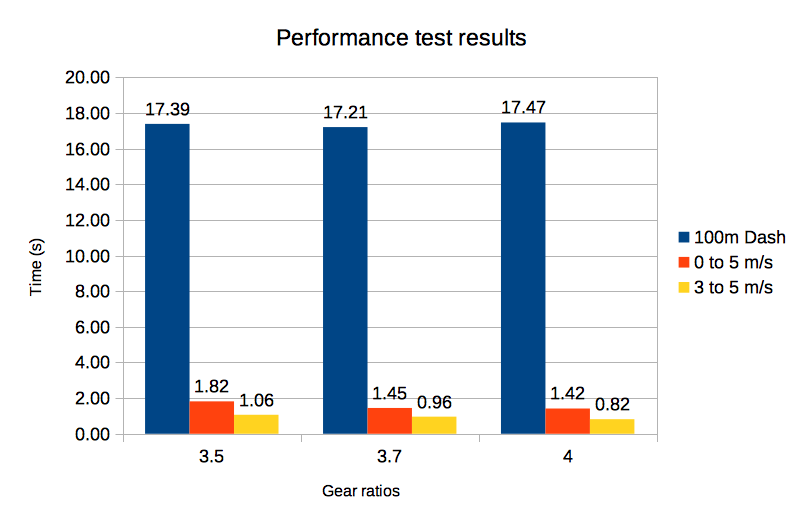
The Results? A massive upset in the 100-Meter Dash:
- 3.5:1 Ratio: 17.39 seconds
- 3.7:1 Ratio: 17.21 seconds 🏆
- 4.0:1 Ratio: 17.47 seconds
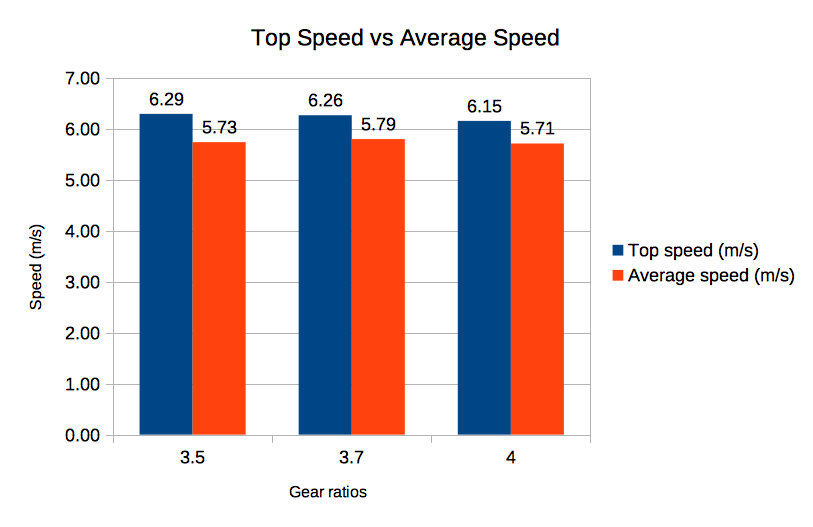
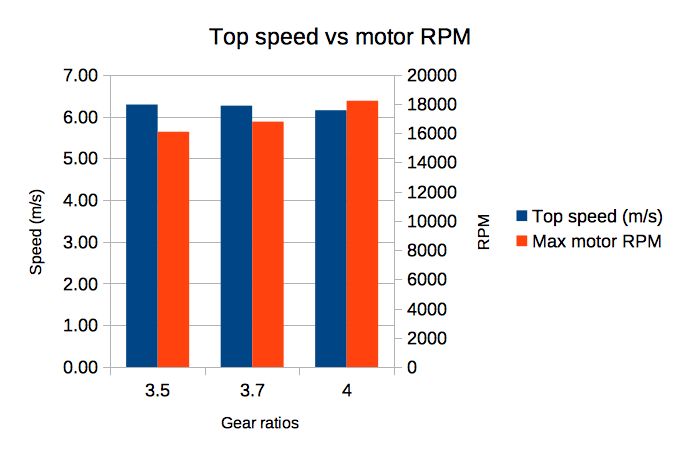
Here is a table with the results in text.
| Gear ratio | Top speed (m/s) | Average speed (m/s) | Max motor RPM |
| 3.5 | 6.29 | 5.73 | 16100 |
| 3.7 | 6.26 | 5.79 | 16793 |
| 4.0 | 6.15 | 5.71 | 18225 |
Wait… how did the 3.7:1 gear beat the “faster” 3.5:1 ratio over a long distance?
The answer comes down to rotational inertia. Our dyno uses a heavy 97g roller skate wheel directly coupled to the axle. This creates a high-load environment that perfectly simulates “heavy track scenarios”—like punching the throttle out of a harsh grass section, recovering speed after landing a jump, or screaming up a steep 45-degree bank climb.
Under this heavy real-world simulation, the 3.5:1 ratio actually choked the motor down to 16,100 Max RPM, while the extra leverage of the 3.7:1 let the motor breathe, roaring up to 16,793 Max RPM and holding a higher average speed across the finish line!
Acceleration Tests
0 to 5 m/s:
- 3.5:1 Ratio: 1.82 seconds
- 3.7:1 Ratio: 1.45 seconds
- 4.0:1 Ratio: 1.42 seconds 🏆
3 to 5 m/s:
- 3.5:1 Ratio: 1.06 seconds
- 3.7:1 Ratio: 0.96 seconds
- 4.0:1 Ratio: 0.82 seconds 🏆
The 4.0:1 ratio proved to be an absolute rocket in both acceleration from a standstill and mid-range recovery. It was blasting from 3 to 5 m/s in just 0.82 seconds (compared to 1.06s on the 3.5:1).
A Deeper Look
Let’s re-examine the distance test again in more detail.
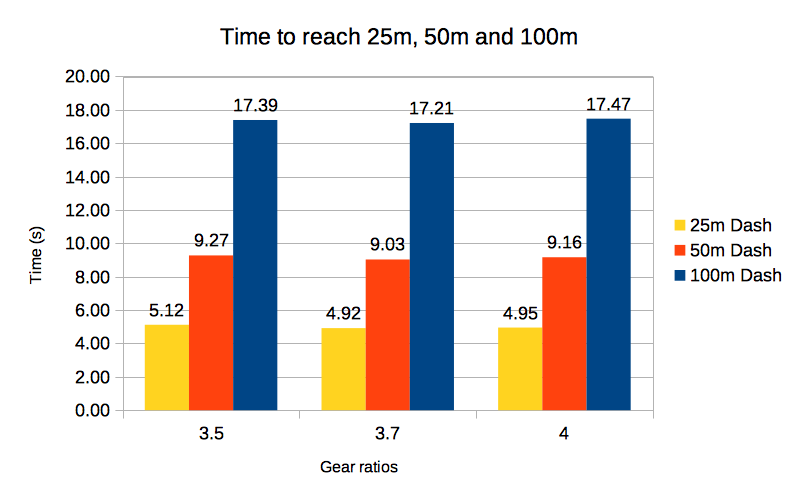
For a short 25-Metre dash, like running the distance of a basic junior cup circuit. 3.7:1 (4.92 seconds) is actually marginally quicker than 4:1 (4.95 seconds) but definitely faster than 3.5:1 (5.12 seconds). Interestingly the 3.5:1 ratio is the slowest among all three.
For the mid distance 50-Metre dash, 3.7:1 is still taking the lead with 9.03 seconds, while 4:1 took second place at 9.16 seconds. 3.5:1 is still the slowest at 9.27 seconds.
For the full 100-Metre dash, that was when the higher top speed 3.5:1 gear ratio managed to crawl back to second place, but still behind the 3.7:1 winner.
We are currently formatting the raw data sheets from our test runs. The complete, granular data sheet will be added to the Annex A of this article within the next few days—stay tuned!
In Summary
We set out to find the best gear ratio to pair with the Tamiya Hyper-Dash PRO motor. The results? While the 4:1 ratio won the acceleration tests (both 0–5 m/s and 3–5 m/s), the 3.7:1 gear ratio came out on top in all the dash tests. Based on our data, the 3.7:1 ratio is practically the best choice for this motor!
What Does The Result Mean to Fellow Racers?
A heavy flywheel acts like an artificial weight penalty that heavily penalises the acceleration phase. On a real track, your car is much lighter, meaning it will break static inertia faster, and the results will shift. Here is the data translates from the “heavy flywheel” to a real, straight line track:
The 3.5:1 Ratio Will Likely Overtake the 3.7:1 in a Real 100m Dash
On a heavy dyno, the 3.5:1 ratio got heavily penalized because it spent too much time slugging through that massive 1.82-second launch phase.
- On a real track: Because a real car doesn’t have a massive heavy flywheel to spin up, the 0-5 m/s launch time for the 3.5:1 ratio will shrink drastically.
- The Result: The 3.5:1 setup will reach its top speed much sooner. Over a massive 100-meter straight line, the 3.5:1 ratio’s higher top speed ceiling (6.29 m/s) will easily overcome the 3.7:1 ratio (6.26 m/s) because it won’t be held back by artificial rotational weight.
The 3.7:1 Ratio Moves from “Drag Strip Champion” to “The Ultimate Cornering Gear”
The dyno showed that the 3.7:1 ratio is incredibly efficient at overcoming heavy, sustained loads while maintaining a high average speed (5.79 m/s).
- On a real track: A straight line doesn’t subject a car to continuous heavy loads, but corners, steep banks, and grass tracks do. Every time a car corners, lateral friction acts exactly like our heavy flywheel—it drags the motor’s RPM down.
- The Result: Our data proves that the 3.7:1 ratio handles severe load changes beautifully. This makes the 3.7:1 your absolute best choice for technical tracks with high corner counts, as it will resist “corner bogging” far better than the 3.5:1.
The 4.0:1 Ratio is an Ultra-Technical Special
Even with a heavy flywheel, the 4.0:1 ratio rocketed from 3 to 5 m/s in 0.82 seconds.
- On a real track: This setup will feel violently fast out of corners and jumps. However, because it hits its RPM wall so early (18,225 RPM), you should only use it if the track layout is so crowded with jumps and sections that the car literally never has a straight line longer than 2 or 3 track sections.
The final piece of the puzzle is, of course, how much power your car can actually put down on the track. This heavily depends on the tyre compound you choose and the track conditions. The good news is that we now have a much better understanding of how these three gear ratios perform.
This experiment is by no means conclusive. Your specific setup might differ from ours, which could produce different results. However, we hope this data provides you with valuable insight into optimizing your car.
What is your main takeaway from this experiment? How would you improve it? Which motor should we test next? Please feel free to leave a comment and share your thoughts on our Facebook page @Mini4Science!
Annex A – Raw Dyno Data (Coming Soon)
We are currently preparing the full data spreadsheets and charts for all 4:1, 3.7:1, and 3.5:1 test runs. Check back shortly to see the granular, run-by-run breakdown!